
Introduction to PALS
The Resuscitation Team
PALS Basic Life Support
Pediatric Advanced Life Support
Resuscitation Tools
Respiratory Distress/Failure
- Recognize Respiratory Distress or Failure
- Respond to Respiratory Distress/Failure
Tachycardia
Cardiac Arrest
Pediatric Post-Resuscitation Care
PALS Essentials
PALS Skills Training
PALS Exam
Respond to Respiratory Distress/Failure
| INITIAL MANAGEMENT OF RESPIRATORY DISTRESS/FAILURE | |||
|---|---|---|---|
| AIRWAY | Open and support the airway | Suction | Consider advanced airway |
| BREATHING | Monitor O2 sats | Supplemental O2 | Nebulizers |
| CIRCULATION | Monitor vitals | Establish vascular access | |
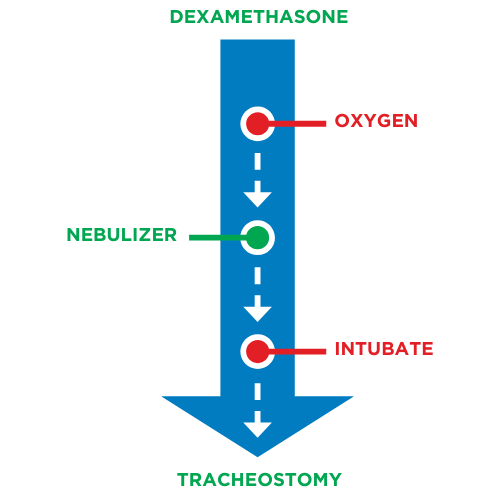
As an example, croup management depends on the severity of the disease.
Dexamethasone, a corticosteroid, can cause hypertension and reduce activation of lymphocytes. No carotid artery pulse detected.
PALS management of respiratory distress/failure is adjusted based on the severity of the current condition. For example, mild asthma is treated with bronchodilator inhalers, but severe asthma (status asthmaticus) may require ET intubation. The provider must continually assess the person’s current needs and adjust care accordingly.
Croup Management
| UPPER AIRWAY | LOWER AIRWAY | ||
|---|---|---|---|
| CAUSE | TREATMENT | CAUSE | TREATMENT |
| CROUP |
| BRONCHIOLITIS |
|
| FOREIGN BODY |
| ASTHMA |
|
| ANAPHYLAXIS |
| ||
| LUNG TISSUE DISEASE | CNS ISSUES | ||
|---|---|---|---|
| CAUSE | TREATMENT | CAUSE | TREATMENT |
| PNEUMONIA |
| OVERDOSE |
|
| PNEUMONITIS |
| TRAUMA |
|
| PULMONARY EDEMA |
| ||
In general, providers commonly work from the least to the most
invasive intervention (top to bottom).If the person presents with severe distress, proceed directly to maneuvers that are more aggressive.
Albuterol is the most common medication used via nebulizer to cause bronchodilation.
Common causes of acute community-acquired pneumonia include Streptococcus pneumonia, Mycoplasma pneumonia, Haemophilus influenza, and Chlamydia pneumonia.
High fever is the most common cause of quiet tachypnea.