ACLS Introduction
The Initial Assessment
ACLS Basic Life Support
- ACLS BLS for Adults
- Initiating the Chain of Survival
- 2020 BLS Guideline Changes
- One Rescuer Adult BLS CPR
- Two Rescuer Adult BLS CPR
- Adult Mouth-to-Mask and Bag-Mask Ventilation
- Adult Basic Life Support (BLS) Algorithm
- BLS for Children/Infants
- CPR Steps for Children
- One-Rescuer BLS/CPR for Infant (newborn to age 12 months)
- CPR Steps for Infants
- Child/Infant Mouth-to-Mouth Ventilation
Advanced Cardiac Life Support
Principles of Early Defibrillation
Systems of Care
ACLS Cases
- ACLS Cases Respiratory Arrest
- Pulseless Ventricular Tachycardia and Ventricular Fibrillation
- Pulseless Electrical Activity Asystole
- Adult Cardiac Arrest Algorithm
- Post-Cardiac Arrest Care
- Adult Immediate Post-Cardiac Arrest Care Algorithm
- Symptomatic Bradycardia
- Adult Bradycardia with Pulse Algorithm
- Tachycardia
- Stable And Unstable Tachycardia
- Adult Tachycardia With Pulse Algorithm
- Acute Coronary Syndrome
- Acute Coronary Syndrome Algorithm
- Acute Stroke
- Acute Stroke Algorithm
ACLS Essentials
ACLS Skills Training
ACLS Exam
Adult Mouth-to-Mask and Bag-Mask Ventilation


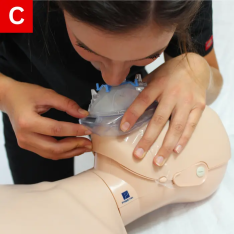
Figure 5
ADULT MOUTH-TO-MASK VENTILATION
In one-rescuer CPR, breaths should be supplied using a pocket mask, if available.
- Give 30 high-quality chest compressions.
- Seal the mask against the person’s face by placing four fingers of one hand across the top of the mask and the thumb of the other hand along the bottom edge of the mask (Figure 5a).
- Using the fingers of your hand on the bottom of the mask, open the airway using the head-tilt/chin-lift maneuver. If a cervical injury is suspected, consider alternative methods. (Figure 5b).
- Press firmly around the edges of the mask and ventilate by delivering a breath over one second as you watch the person’s chest rise. (Figure 5c).
- If there is disinterest in providing ventilation (because of an airborne illness suspicion), hands-only CPR would be an equivalent option.
ADULT BAG-MASK VENTILATION IN TWO-RESCUER CPR


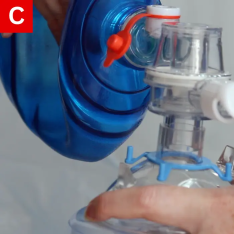
If two people are present and a bag-mask device is available, the second rescuer is positioned at the victim’s head while the other rescuer performs high-quality chest compressions.
- Deliver 30 high-quality chest compressions while counting out loud (Figure 6a).
- The second rescuer holds the bag-mask with one hand using the thumb and index finger in the shape of a “C” on one side of the mask to form a seal between the mask and the face, while the other fingers open the airway by lifting the person’s lower jaw (Figure 6b). If possible, keep the mask on the face at all times, only remove if necessary, to reduce gross exhalation exposure to rescuers.
- The second rescuer gives two breaths over one second each as you watch the person’s chest rise (Figure 6c).
- Practice using the bag valve mask; it is essential to forming a tight seal and delivering effective breaths.