- ACLS BLS for Adults
- Initiating the Chain of Survival
- 2020 BLS Guideline Changes
- One Rescuer Adult BLS CPR
- Two Rescuer Adult BLS CPR
- Adult Mouth-to-Mask and Bag-Mask Ventilation
- Adult Basic Life Support (BLS) Algorithm
- BLS for Children/Infants
- CPR Steps for Children
- One-Rescuer BLS/CPR for Infant (newborn to age 12 months)
- CPR Steps for Infants
- Child/Infant Mouth-to-Mouth Ventilation
- ACLS Cases Respiratory Arrest
- Pulseless Ventricular Tachycardia and Ventricular Fibrillation
- Pulseless Electrical Activity Asystole
- Adult Cardiac Arrest Algorithm
- Post-Cardiac Arrest Care
- Adult Immediate Post-Cardiac Arrest Care Algorithm
- Symptomatic Bradycardia
- Adult Bradycardia with Pulse Algorithm
- Tachycardia
- Stable And Unstable Tachycardia
- Adult Tachycardia With Pulse Algorithm
- Acute Coronary Syndrome
- Acute Coronary Syndrome Algorithm
- Acute Stroke
- Acute Stroke Algorithm
Airway Management


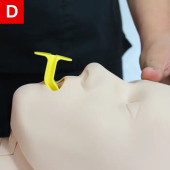
Figure 10
If bag-mask ventilation is adequate, providers may defer the insertion of an advanced airway. Health care providers should make the decision as to the appropriateness of placing an advanced airway during the ACLS Survey. The value of securing the airway must be balanced against the need to minimize the interruption in perfusion that results in halting compressions during airway placement.
Basic airway equipment includes the oropharyngeal airway (OPA) and the nasopharyngeal airway (NPA). The primary difference between an OPA (Figure 10a) and an NPA (Figure 10b) is that an OPA is placed in the mouth (Figure 10c and 10d) while an NPA is inserted through the nose. Both airway equipment terminate in the pharynx. The main advantage of an NPA over an OPA is that it can be used in either conscious or unconscious individuals because the device does not stimulate the gag reflex.
Advanced airway equipment includes the laryngeal mask airway, laryngeal tube, esophageal-tracheal tube, and endotracheal tube. Different styles of these supraglottic airways are available. If it is within your scope of practice, you may use advanced airway equipment when appropriate and available.